
Wedding Photographer vs Videographer: Do You Need Both?
19 June 2026 · 8 min read
Quick answer: Most couples prioritise a photographer — about 90% of Australian couples hire one, at an average of around $3,600 — because photos are the images you'll display and share. A videographer (averaging roughly $3,100 to $4,000) captures movement, sound and the day's atmosphere in a way stills can't. If the budget allows, many couples book both, often as a discounted package from a single team.
| Photographer | Videographer | |
|---|---|---|
| Average cost | ~$3,600 | ~$3,100–$4,000 |
| Couples who book | ~90% | Fewer than photographers |
| Captures | Still images to frame and share | Movement, sound and atmosphere |
| Best for | The images you'll display | Reliving the day and your vows |
Almost every couple books a photographer. Far fewer agonise over whether to add a videographer too, and once the budget tightens, film is often the first thing to go. Yet the two capture your day in completely different ways, and understanding that difference is the only way to decide what you will regret missing.
This guide breaks down the real photographer vs videographer decision for an Australian wedding: what each one actually delivers, whether you genuinely need both, how same-team and separate suppliers compare, and how to brief them so they share the day rather than fight over it.
What each one actually captures
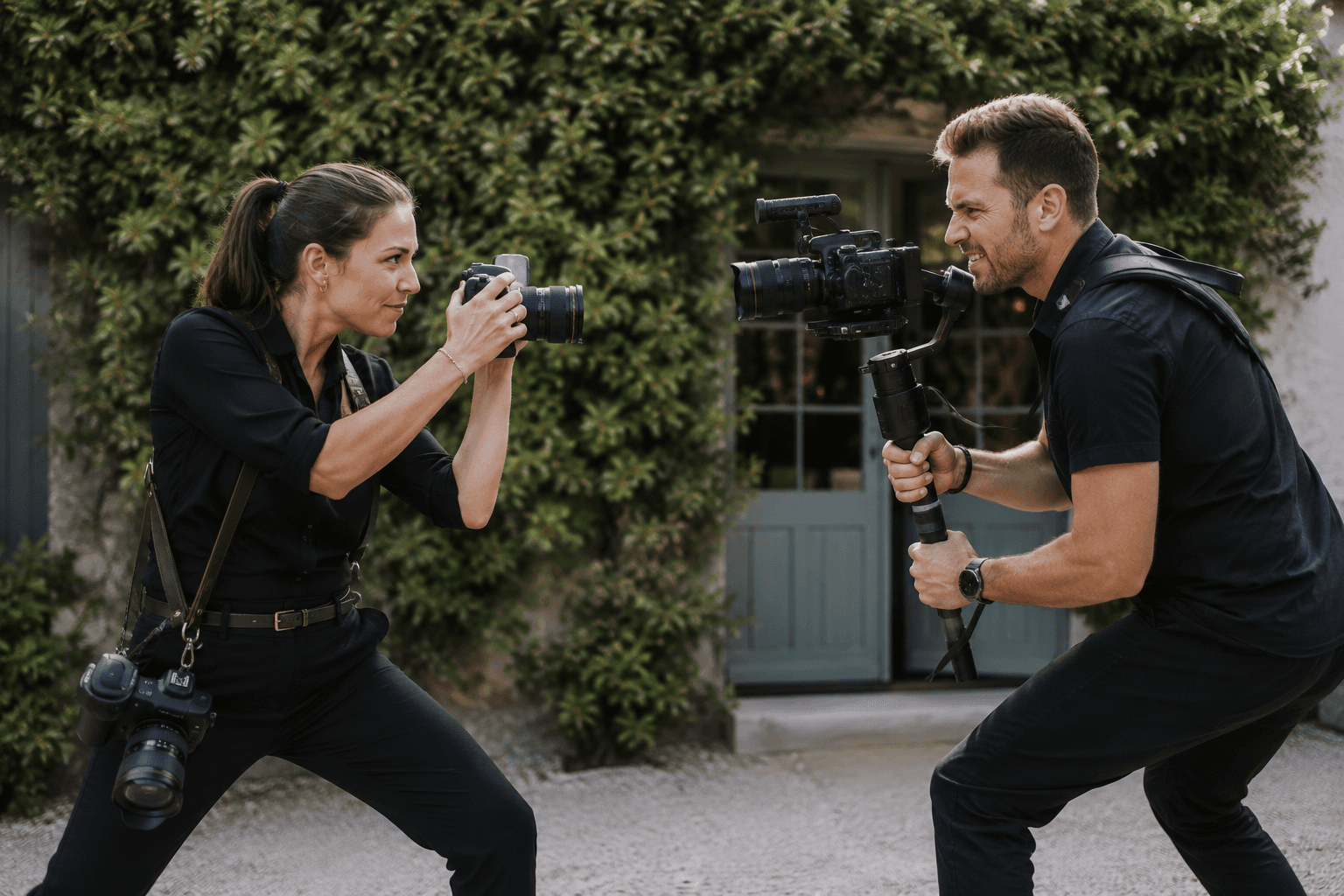
It is tempting to think of a photographer and videographer as two people doing the same job with different gear. They are not. They capture different layers of the same day, and each layer is something the other cannot replace.
What a photographer gives you
A photographer delivers stills: the frameable, printable, hang-on-the-wall images you will scatter through your home and send to family. Photos are instantly shareable, easy to flick through, and they freeze the single perfect frame, the look on a parent's face, the confetti mid-air, the detail of the rings. They are the medium most people interact with daily, and the one your grandchildren will most likely pull off a shelf.
What a videographer gives you
A videographer captures what a still never can: movement, sound and time. The tremble in a voice during the vows. The exact words of the speeches. Your grandmother laughing, your dog bolting down the aisle, the roar of the room as you are announced. A wedding film replays the day rather than summarising it, and the audio alone, your promises in your own voices, is something couples consistently say they treasure most years later.
Put simply, photos are how you will see your wedding and film is how you will relive it. They answer different emotional needs, which is exactly why the question of needing both is harder than it first looks.
So do you actually need both?
There is no universal answer, only an honest one based on your priorities and budget. A few guiding principles help.
- If you can only afford one, most couples prioritise photography. Stills are more versatile, easier to share, and the cultural default, so a photographer is the safer single investment.
- Film is the most common deep regret. Survey almost any married couple and you will hear the same thing: the people who skipped video wish they had not, far more often than the reverse. Once the day is gone, there is no second take.
- Consider what you respond to. If you cry at a good highlight reel and love hearing voices and music, video will matter enormously to you. If you live for a beautiful printed frame and rarely rewatch videos, photography may be enough.
- Think about the irreplaceable people. If an elderly relative is travelling to be there, motion and sound capture them in a way a photo cannot.
If the budget genuinely will not stretch, a strong photographer alone is a perfectly good decision. But before you rule out film, it is worth pricing a modest video package rather than assuming it is out of reach, because the trade-offs are not always what couples expect.
Same team or separate suppliers?
Once you decide on both, the next choice is whether to hire a single company that offers photo and video together, or to book two separate specialists. Each has clear pros and cons.
Booking a same-team package
Many Australian studios offer combined photo-and-video packages with a coordinated crew. The advantages are real:
- They are used to working side by side, so they instinctively stay out of each other's frames and share key moments without colliding.
- One point of contact for booking, timelines and payment makes planning simpler.
- A consistent creative vision, since the photos and film often share a colour palette and storytelling style.
- Frequently better value than two premium suppliers booked separately.
The trade-off is that you are trusting one company to be excellent at two very different crafts. Some studios shine at both; others are clearly stronger at one. Review full galleries and full films before assuming the package is uniformly good.
Booking separate specialists
Hiring a dedicated photographer and a dedicated videographer lets you choose the very best of each, with a style you love in both mediums. The catch is coordination: two suppliers who have never met must share tight spaces and fleeting moments. It can work beautifully, but it puts more responsibility on you to introduce them and align expectations. If you go this route, it helps to research each craft on its own, starting with our guide on how to choose a wedding photographer before applying the same scrutiny to film.
Budget trade-offs and combined packages
Money is usually what forces the decision, so be realistic and strategic about it. As a rough guide only, professional wedding video in Australia tends to sit in a similar broad range to professional photography, and adding film to an existing photography booking can be a meaningful additional spend rather than a small extra. Treat any figures as approximate and always confirm current pricing directly.
A few ways to make both work within a sensible budget:
- Look at combined packages first. A studio offering both can be more affordable than two separate premium bookings.
- Match coverage to your priorities. You do not need identical hours for each. You might book full-day photography but shorter video coverage focused on the ceremony and speeches.
- Choose deliverables deliberately. A shorter highlight film costs less than a full-length feature edit; you can always add the longer cut later.
- Trim elsewhere. Couples often find that reallocating from less memorable line items, rather than cutting film entirely, lets them keep both.
When comparing quotes, look past the headline price to coverage hours, the number of shooters, and exactly what you receive. To compare options for each craft, browse our directories of wedding photographers and wedding videographers and shortlist suppliers whose work genuinely moves you.
How to brief both to share the day
Two talented suppliers can still produce a frustrating result if they trip over each other all day. A little coordination prevents the classic problems: a videographer's light flaring a photo, a photographer stepping into a video frame, or both crowding the couple at the same instant. Whether they are a same team or separate, do this:
- Introduce them before the day. If they are separate suppliers, connect them by email or get them on a quick call so they can agree on positioning and signals.
- Share one master timeline. Give both the same run sheet with ceremony, portraits, speeches and first-dance times so neither is caught off guard.
- Set priority on the big moments. Agree who gets the prime angle for the first kiss, the rings and the speeches, so they alternate rather than compete.
- Brief your must-have shots once. Send both the same list of non-negotiable moments and people, so nothing important is missed by either.
- Let the professionals lead on the day. Once they are briefed, trust them. Good suppliers solve the choreography themselves so you never notice it.
The bottom line
Photography and videography are not competitors, they are partners that capture different halves of the same memory. If your budget allows only one, lead with photography. If it can stretch, film is the addition couples regret skipping most. And whichever way you go, the suppliers you choose, and how well you brief them to share the day, matter just as much as the gear in their hands.
Frequently asked questions
- Do you need both a photographer and a videographer?
- Not necessarily. Photography is the higher priority for most couples — about 90% hire a photographer — because photos are what you frame and share. Video adds movement, voices and atmosphere; book both if your budget allows, ideally as a combined package to save money.
- How much does a wedding photographer cost in Australia?
- An Australian wedding photographer averages around $3,600, with most full-day packages between $3,000 and $5,000. Coverage length, albums and a second shooter are the main things that move the price.
- How much does a wedding videographer cost in Australia?
- A wedding videographer typically costs around $3,100 to $4,000 for full-day coverage, with shorter packages from about $1,500 and premium cinematographers charging $7,000 or more. Booking photo and video from one team often saves money.