How to Get Legally Married in Australia: NOIM, Celebrants & Paperwork Explained
6 June 2026 · 7 min read
Quick answer: To marry legally in Australia you must lodge a Notice of Intended Marriage (NOIM) with an authorised celebrant at least one month (and no more than 18 months) before the wedding, be at least 18, not already married or marrying a close relative, and both freely consent. The ceremony needs an authorised celebrant, two witnesses over 18, and the legally required words. Your celebrant then registers the marriage with Births, Deaths and Marriages.
Planning a wedding is mostly about the fun stuff, but underneath the flowers and the first dance sits a small pile of legal paperwork that has to be done in the right order. The good news is that the process is refreshingly straightforward once you understand it. Here is exactly how to get married in Australia, from the first form you lodge to the certificate that lands in your letterbox afterwards.
Start With the Notice of Intended Marriage (NOIM)
Every legal marriage in Australia begins with one document: the Notice of Intended Marriage, almost always shortened to the NOIM. It is a Commonwealth form that tells the authorities you intend to marry, who you are, and roughly when and where the ceremony will take place.
The single most important rule to remember is the timing window. The NOIM must be lodged with your authorised celebrant at least one calendar month before your wedding date, and it cannot be lodged more than 18 months beforehand. In other words, your completed notice needs to sit with your celebrant for a minimum of one month, and it stays valid for up to a year and a half.
That one-month minimum trips up more couples than anything else, especially those planning a quick or last-minute wedding. There is a process for shortening the notice period in genuinely exceptional circumstances, but it is granted sparingly by a prescribed authority and is not something to rely on. The safe approach is simple: sort your celebrant and lodge your NOIM early.
How the NOIM Is Lodged
You and your partner complete the form together, then sign it in front of an authorised witness, such as your celebrant, a Justice of the Peace, a legal practitioner, a doctor or a police officer. You can fill it in well ahead of time and post or email it to your celebrant to get the clock ticking, then sign it in person later if needed. Once your celebrant has the signed notice, your one-month countdown has officially started.
The Documents You Need
When you lodge your NOIM, your celebrant has to sight evidence of a few key facts. You do not necessarily need every document on day one, but everything must be confirmed before the ceremony goes ahead.
- Proof of date and place of birth — usually a birth certificate or a valid passport.
- Proof of identity — typically a passport or driver licence.
- Evidence of the end of any previous marriage — if either of you has been married before, you must provide a divorce certificate or the death certificate of a former spouse.
If your documents are in another language, you will generally need an official translation. It is worth gathering these early, because tracking down an old birth or divorce certificate can take longer than you expect, and your celebrant cannot finalise the marriage without them.
Who Can Legally Marry You
In Australia, only an authorised celebrant can solemnise a legally binding marriage. There are a few categories of authorised celebrant, and the right choice depends entirely on the kind of ceremony you want.
Civil Celebrants
A Commonwealth-registered civil celebrant is the most popular choice for modern Australian weddings. They can marry you almost anywhere — a beach, a backyard, a vineyard or a function venue — and give you complete freedom over the style and tone of your ceremony. If you want a personalised, non-religious wedding, this is usually the way to go. You can browse and compare options through our directory of marriage celebrants to find someone whose approach suits you.
Ministers of Religion
Recognised ministers of religion registered as authorised celebrants can perform marriages within the traditions of their faith. If a religious ceremony matters to you, this is the path, though the format will follow the conventions of that particular denomination.
State and Territory Officers
Registry officers at your state or territory births, deaths and marriages office can also perform marriages, usually as a simple, low-cost ceremony at the registry. This is a practical option for couples who want the legal side handled with minimum fuss.
Whichever you choose, make sure the person is genuinely authorised — a friend cannot simply officiate your wedding and make it legal unless they hold the proper authorisation. Take time when choosing your celebrant, because they guide you through the paperwork as well as the ceremony itself.
The Required Legal Wording vs Your Personal Vows
One of the most common questions couples ask is whether they can write their own vows. The answer is yes — but with one fixed exception.
Australian law requires that certain words are said during every marriage ceremony, no matter how personal or relaxed the rest of it is. Your celebrant must include the Monitum, a short statement explaining the nature of marriage under Australian law. You and your partner must also each say a legally prescribed line declaring that you take the other as your lawful wedded spouse. These words are non-negotiable and must be spoken for the marriage to be valid.
Around that small legal core, almost everything else is yours to shape. Your personal vows, readings, rituals, music and the overall structure can be written exactly as you like. A good celebrant will weave the required legal wording seamlessly into a ceremony that still feels entirely like yours, so guests rarely notice the join. If you are unsure how this works in practice, your celebrant can show you sample ceremonies that blend the formal and the heartfelt.
Two Witnesses and Signing the Certificates
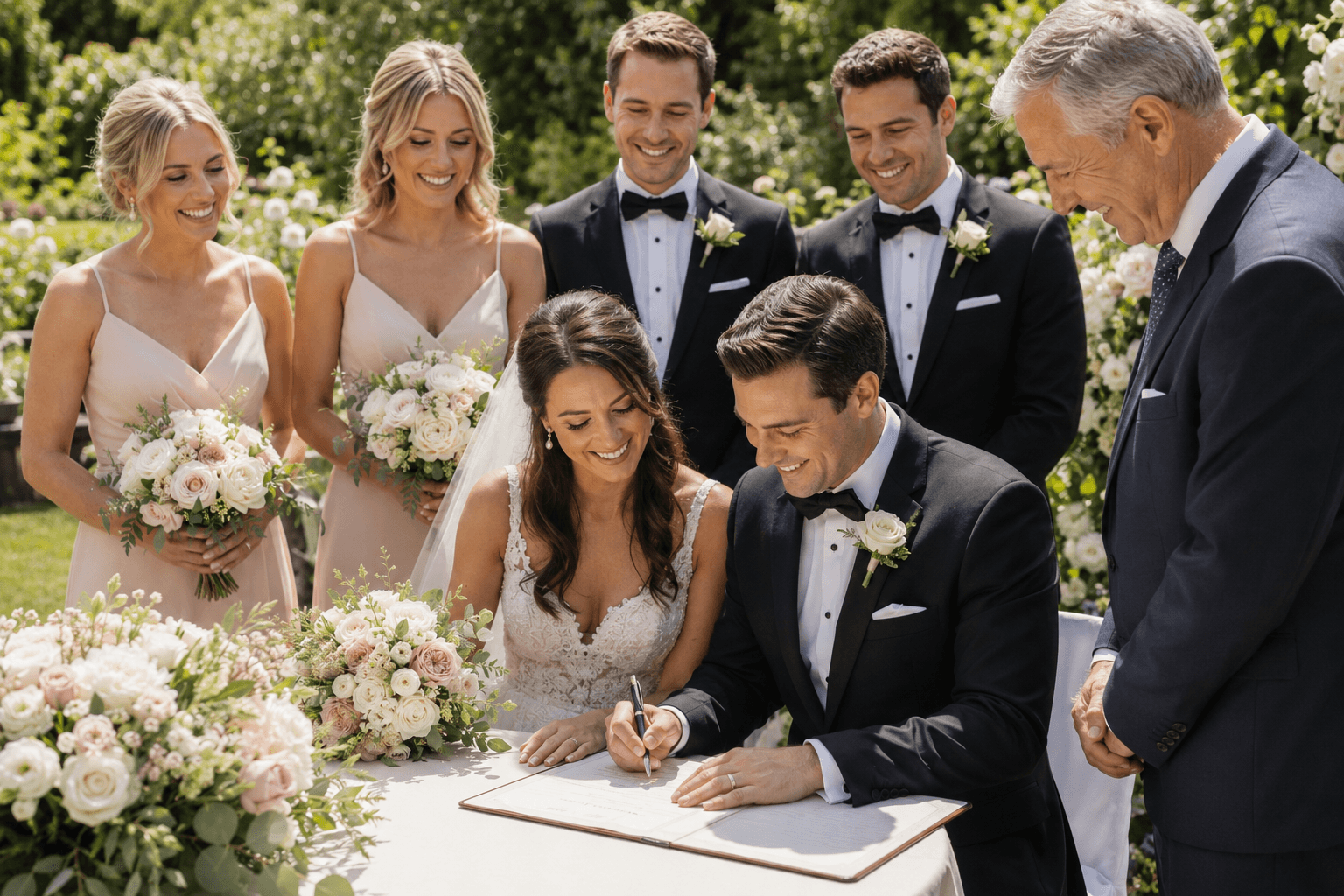
On the day, your marriage must be witnessed by two people aged 18 or over. They watch the ceremony and then sign the marriage documents alongside you, your partner and your celebrant. These witnesses can be anyone you choose — family, friends or even your photographers — as long as they understand enough English to know what is taking place.
At the ceremony you will typically sign three documents: an official certificate that goes to the registry, the form your celebrant retains, and a decorative ceremonial certificate that you keep as a memento. That ceremonial certificate is lovely to have, but it is not the legal proof of your marriage.
Registering the Marriage Afterwards
The wedding is not quite the end of the legal process. After the ceremony, your celebrant is responsible for registering your marriage with the births, deaths and marriages registry in your state or territory, generally within a couple of weeks.
Once it is registered, you can apply for an official marriage certificate from that registry. This is the document that actually proves you are married and the one you will need for things like changing your name, updating your passport, or sorting out banking and superannuation. The pretty certificate you signed on the day will not be accepted for these purposes, so it is worth ordering the official version reasonably soon after the wedding. There is usually a modest fee for it, and processing times vary by state.
A Simple Order of Events
- Choose your celebrant and confirm they are authorised.
- Lodge your NOIM at least one month, and no more than 18 months, before the date.
- Gather your documents — proof of birth, identity and, if relevant, the end of any prior marriage.
- Hold the ceremony with two adult witnesses and the required legal wording.
- Sign the certificates on the day.
- Let your celebrant register the marriage, then order your official certificate.
Handle these steps in order and the legal side of getting married in Australia becomes the easy part of wedding planning. When you are ready to begin, the natural first move is finding the right marriage celebrant to guide you through it.
Frequently asked questions
- What are the legal requirements to get married in Australia?
- You must not already be married or marrying a close relative, be at least 18 (or 16–17 with court approval for one party), understand and freely consent, lodge a Notice of Intended Marriage, say the legally required words, and be married by an authorised celebrant in front of two witnesses aged over 18.
- How far in advance do you lodge the NOIM?
- The Notice of Intended Marriage must reach your authorised celebrant at least one month and one day before the wedding, and no more than 18 months before. In limited circumstances a prescribed authority can approve a marriage at shorter notice.
- Do you need witnesses to get married in Australia?
- Yes — every legal marriage in Australia needs two witnesses who are aged over 18 and can understand the ceremony. They sign the marriage certificates alongside you and your celebrant on the day.
- Is the certificate from the ceremony the official marriage certificate?
- No. The decorative certificate your celebrant hands you on the day is ceremonial only. The official marriage certificate must be applied for from your state or territory Births, Deaths and Marriages registry — that's the one you need to change your name or prove you're married.